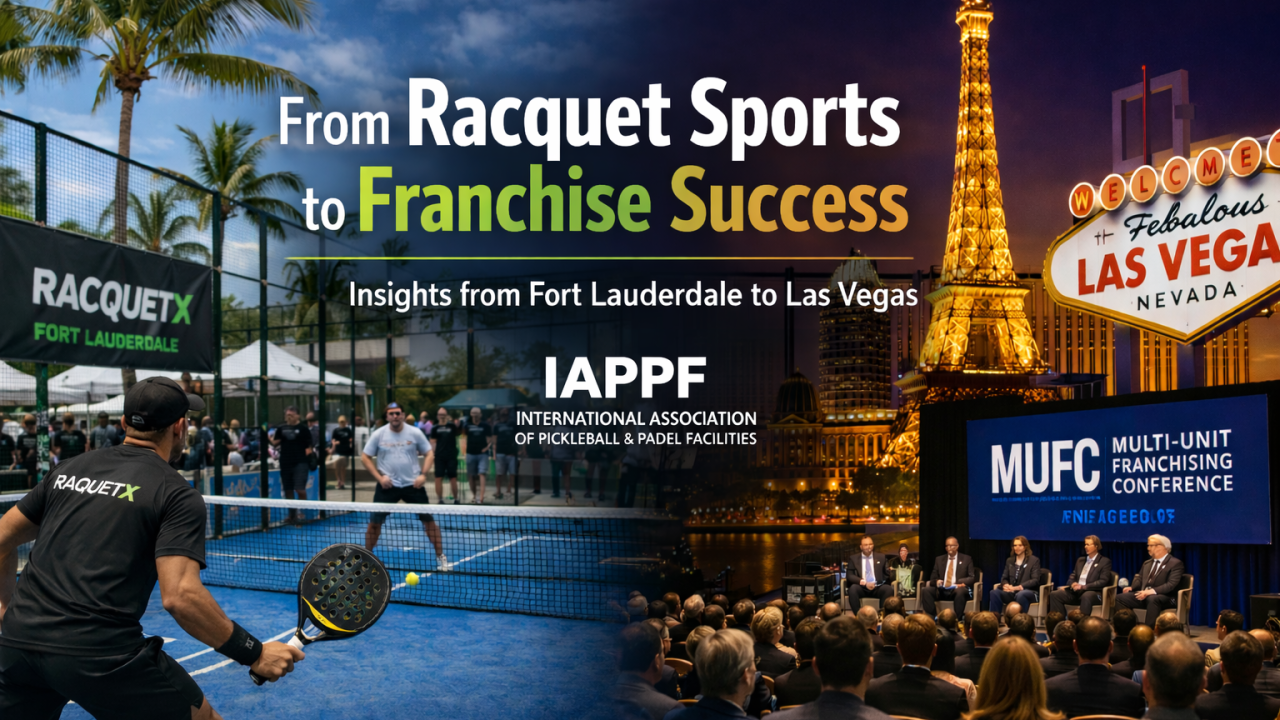
Over the past couple of weeks, I had the opportunity to spend time in two very different — but increasingly connected — worlds: racquet sports at the RacquetX / IAPPF Conferences in Fort Lauderdale, and franchise growth at the Multi-Unit Franchising Conference in Las Vegas.
Different audiences. Different conversations. But the same underlying question: who is actually building scalable, durable businesses, and who is just riding momentum?
The Racquet Sports Industry Is Growing Fast — But Still Early
At RacquetX, the energy around padel is undeniable. New operators are entering the space, vendors are scaling quickly, investor curiosity is increasing, and conversations around programming, technology, and monetization are becoming more structured. But underneath that momentum, there is still a gap: most operators are still thinking like facilities, not platforms.
There is a big difference between opening courts and building a system that drives revenue, retention, and repeatability. The winners in this space will not just have great courts — they will have structured programming, defined member journeys, data-driven operations, and clear unit economics.
Franchising Has a Discipline That Racquet Sports Needs
Then you go to the Multi-Unit Franchising Conference, and it is a completely different level of conversation. Franchise operators are asking: What are my margins at scale? How fast can I replicate this unit? What breaks when I go from 1 to 10 locations? Where is the operational risk?
There is a level of rigor that does not always exist yet in emerging sports concepts. Franchising forces clarity: systems over personalities, process over passion, replication over one-off success. And that is exactly what the racquet sports industry is starting to need.
The Biggest Gap: People, Process, Product Alignment
Across both events, one thing became clear: most businesses are strong in one of these, but rarely all three. Great community with weak systems. Good structure with poor experience. Beautiful facilities with inconsistent execution.
The real opportunity sits at the intersection: aligned people, scalable process, and consistent product equals sustainable growth. That is where franchising and racquet sports start to converge.
Multi-Unit Operators Want More Than Cool Concepts
The experienced franchise operators I spoke with in Las Vegas are not chasing trends. They are asking whether the model can produce predictable cash flow, whether there is operational support, whether they can trust the brand to scale with them, and what things look like at five or more units. This is important for emerging industries like padel: the next phase of growth will not be driven by early adopters — it will be driven by disciplined operators.
The Shift That Is Coming
Racquet sports, especially padel, are entering a transition phase: from passion-driven growth, first-mover advantage, and concept validation — to system-driven scaling, brand standardization, and institutional capital and franchise expansion. That shift will separate facilities from platforms, operators from brands, and momentum from longevity.
What stood out most over the past two weeks is this: industries do not mature because of demand — they mature because of discipline. Racquet sports have the demand. Franchising brings the discipline. The opportunity now is combining both, intentionally.