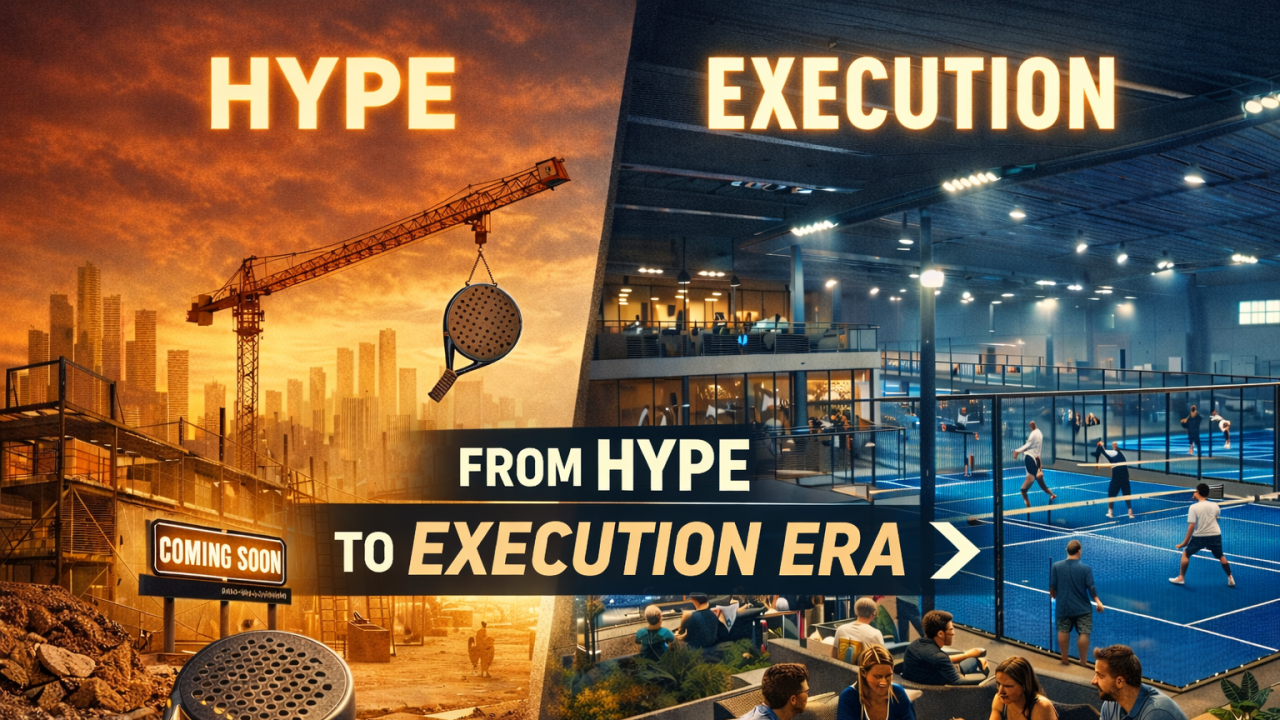
For the past few years, the conversation around padel has been dominated by one word: growth. Growth in courts. Growth in players. Growth in global attention. And while all of that is true, it is no longer the most interesting part of the story.
Because quietly — especially here in the U.S. — padel has crossed an important threshold. It is moving from hype to execution.
The Hype Phase Is Over
Not long ago, most conversations sounded like: “Padel is coming.” Today, that is no longer a question. Facilities are opening. Capital is being deployed. Operators are stepping into real-world challenges. The narrative has shifted from “if” to “how well.” And that is a very different game.
The U.S. Opportunity Isn't Saturation — It's Awareness
Globally, padel is a proven sport with tens of millions of players and a rapidly expanding footprint. But in the U.S., something interesting is still happening: most people have not even been introduced to it yet. That is not a weakness — it is the opportunity. We are not fighting for market share. We are still building the market itself. Which means the winners will not just be the ones who showed up early — they will be the ones who introduce the sport the right way.
This Isn't a Court Business — It's an Experience Business
One of the biggest misconceptions right now is that padel is just about building courts. It is not. Courts are the entry point. The real product is everything around them: community, programming, coaching, events, hospitality, and atmosphere.
Padel sits at the intersection of sport and social connection in a way very few activities do. It behaves less like traditional racquet sports and more like a blend of boutique fitness, golf culture, and modern social clubs. That shift matters — because it completely changes how facilities need to be designed and operated.
The Real Bottleneck: Execution
There is no shortage of interest in padel right now. What is scarce is execution at scale. The real constraints are not players — they are the right real estate, disciplined capital deployment, trained coaching pipelines, operational systems that actually work, and a consistent customer experience.
This is where the gap will widen. Because building a court is one thing. Building a repeatable, high-quality experience across multiple locations is something else entirely.
Operators Will Define the Market
Over the next 12 to 24 months, we are going to see a separation — not between those who believe in padel, but between those who can operate it and those who cannot. The winners will not necessarily be the first to market, or even the most capitalized. They will be the ones who can create consistent experiences, build real communities, and execute with discipline, not just enthusiasm.
Courts don’t build communities. Operators do.
Where This Is Going
A few things are becoming clear: the U.S. market is still massively underdeveloped, demand will grow as awareness grows, the business model is evolving beyond just court rental, and scalable systems — not just great locations — will determine long-term success.
Padel does not have a demand problem. It has a distribution and execution problem. And that is exactly what makes this moment so interesting.
We are no longer early in awareness. But we are still early in getting it right. And in emerging industries, that is usually where the real value is created. The next phase will not be about who showed up first. It will be about who figured out how to do it best.